
Who are you?
We are Narvians — people who have lived in Estonia for at least three generations. We were born here, as were our parents and grandparents, while Russian has remained the language we speak at home.
We are not simply one thing or another. Over the generations, our languages, cultures and memories have become intertwined, like strands of a braid.
Our connection to the minority
Our identity is rooted in the place where we live. Russian is the language of our families and our homes. Estonian is our second language — the language of our colleagues, our friends and our everyday life in Estonia.
There is even a word for this kind of everyday speech: segakeel — a mixed language made up of elements of two or more languages. For many of us, Russian and Estonian naturally come together in the same sentence. It is not something we consciously plan; it has simply become part of the way we speak and live.
Today, our children are also being born and raised in Estonia. They are a new generation, creating their own identity from everything they have inherited and everything they experience around them.
A personal moment
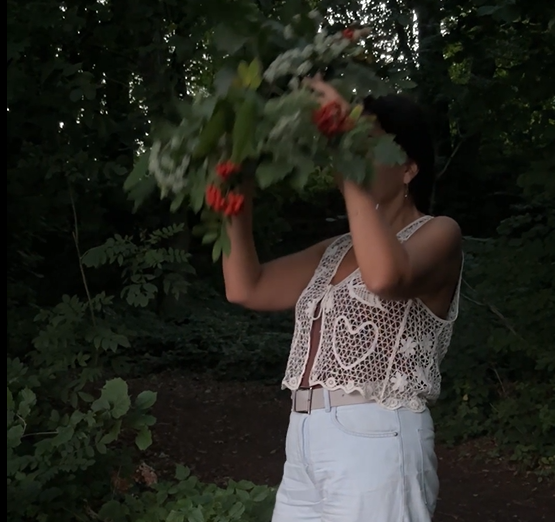
In our video, girls braid each other’s hair, weave wreaths and then release them into the water.
For us, these actions are more than a tradition. Wreaths are connected to Jaanipäev, the Estonian Midsummer celebration, as well as Ivanov Day — traditions that have their own place in the cultural memory of our families and communities.
The braid reminds us of how our identities are woven together — family, language, culture and place. The wreath connects us to nature, to the land and to the generations before us.
The Suprjadki song “Vihma sajab как с ведра” is also an example of segakeel — a mixed language made up of elements of two or more languages. Russian and Estonian come together naturally in the song, just as they come together in our everyday speech and in our lives.
Why it matters to us today
What unites us is the land we live on.
We belong to Estonia. Russian is part of our family identity, while Estonian is our second language — the language we share with our colleagues, friends and neighbours.
Our identity does not have to be divided between two cultures. It can hold both. It can be mixed, layered and constantly changing.
Our children are already a new generation. Their identity will be different from ours — and that is not a loss. It is a continuation.
Like a braid, identity becomes stronger when different strands come together.